
GUIDE
Electronic visit verification (EVV) for home care
EVV confirms that the right caregiver reached the right client, at the right time and place. CareKindle captures that proof at the door and turns it into a live board your office can act on.
What EVV is, and why agencies adopt it
Electronic visit verification is the practice of electronically recording six basic facts about every home-care visit: who received care, who delivered it, the service provided, the date, the time the visit started and ended, and where it happened. Instead of a paper timesheet filled in after the fact, the record is captured the moment care begins.
Home-care agencies adopt EVV for reasons that go well beyond timekeeping. It protects clients by confirming that a scheduled visit actually occurred, it protects caregivers by giving them an objective record of the hours they worked, and it protects the agency when a funder, family member, or regulator asks for evidence that care was delivered as planned.
Because each visit record ties a caregiver to a client at a specific time, EVV also strengthens your privacy posture. Access to that information is recorded, which keeps your practices aligned with PHIPA and PIPEDA expectations around handling personal health information.
- Confirms the visit happened, not just that it was scheduled
- Gives caregivers an objective, defensible record of hours worked
- Produces the proof funders and families ask for
- Records who accessed visit information and when
GPS check-in at the door
A CareKindle visit begins when the caregiver checks in from the client home on their phone. The app captures the time and the device location at that moment, so the start of the visit is anchored to where care is actually being given rather than to a number typed in later.
You set the rules that fit your agency. A configurable geofence around each client address lets you decide how close a check-in must be, and you choose whether an out-of-range attempt is blocked outright or allowed with a recorded reason. The same applies at check-out, so the full visit window is verified end to end.
When circumstances call for it, such as a community outing, a dead-zone address, or a forgotten phone, supervisors can record a manual verification with a reason. Nothing is silently dropped: the manual entry is captured as part of the same record so the history stays complete and honest.
A clock-out window that keeps hours honest
A shift that is never closed is the most common way EVV records go wrong: a caregiver forgets to clock out, then completes the visit hours or days later, and the worked time, and the pay tied to it, ends up wildly overstated. CareKindle closes that gap with a configurable clock-out window.
You set the window in Settings (it defaults to three hours). Once a visit is more than that far past its scheduled end, the caregiver can no longer clock themselves out from the app; they are told to ask the office instead. A coordinator then records the clock-out on their behalf at the real time, so the correction is deliberate and attributed rather than guessed at much later.
The window applies to the caregiver, not to your office. Manual records made by an administrator or coordinator are exempt by design, because correcting a forgotten or unusual clock-out is exactly their job. A visit that is actively being worked is treated the same way: rather than being cancelled out from under the caregiver, an in-progress visit is clocked out so the time worked is recorded and paid.
- Caregivers cannot self-complete a shift long after it ended
- The window is set per agency in Settings (default three hours)
- Past the window, the office records the clock-out at the real time
- Office and admin manual records are exempt so they can make corrections
A live monitoring board and an exception queue
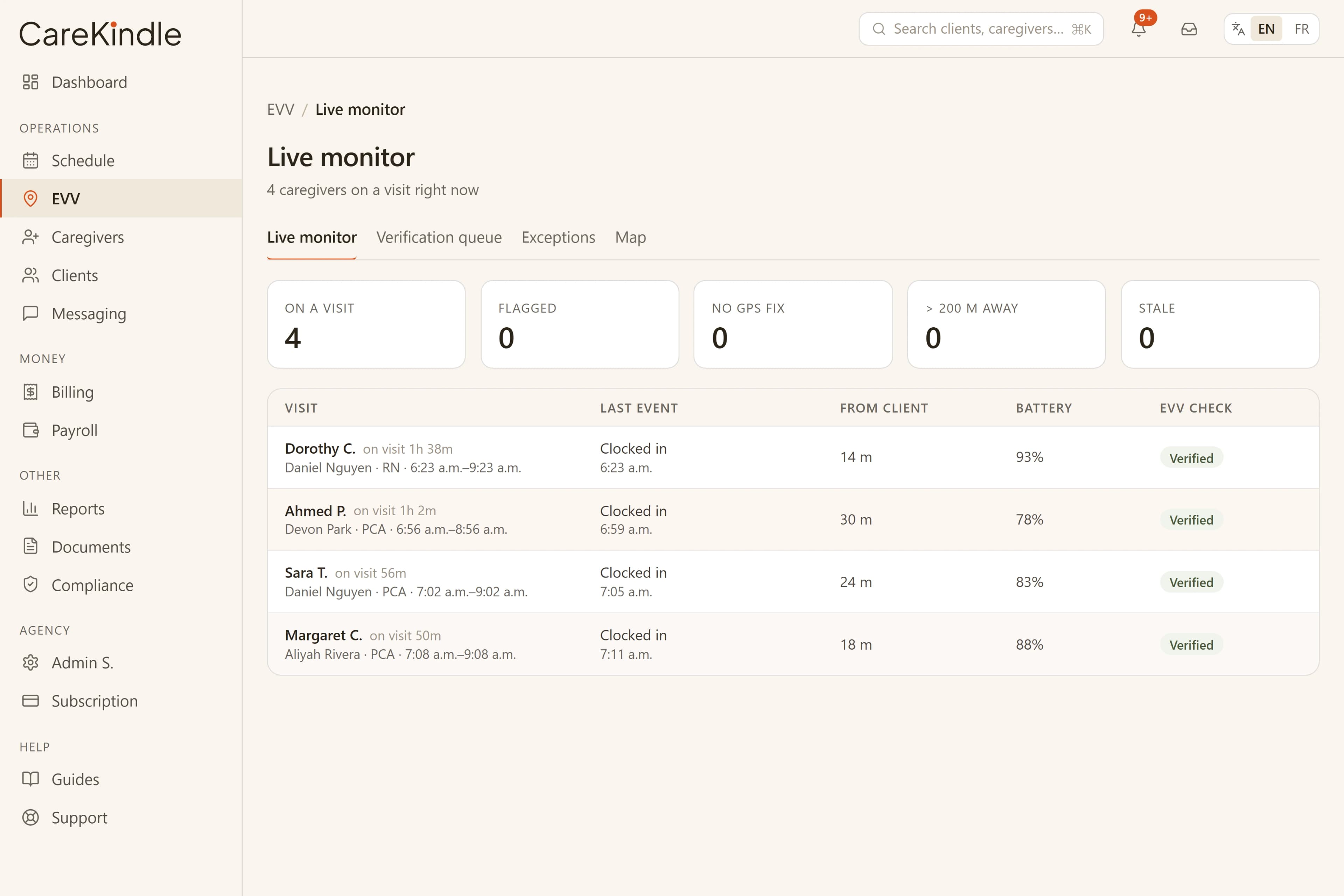
The monitoring board gives your office a single live view of the day: visits not yet started, visits in progress, and visits already complete. Coordinators can see at a glance whether the schedule is being met without phoning each caregiver, which matters most during the early-morning and shift-change windows when problems cluster.
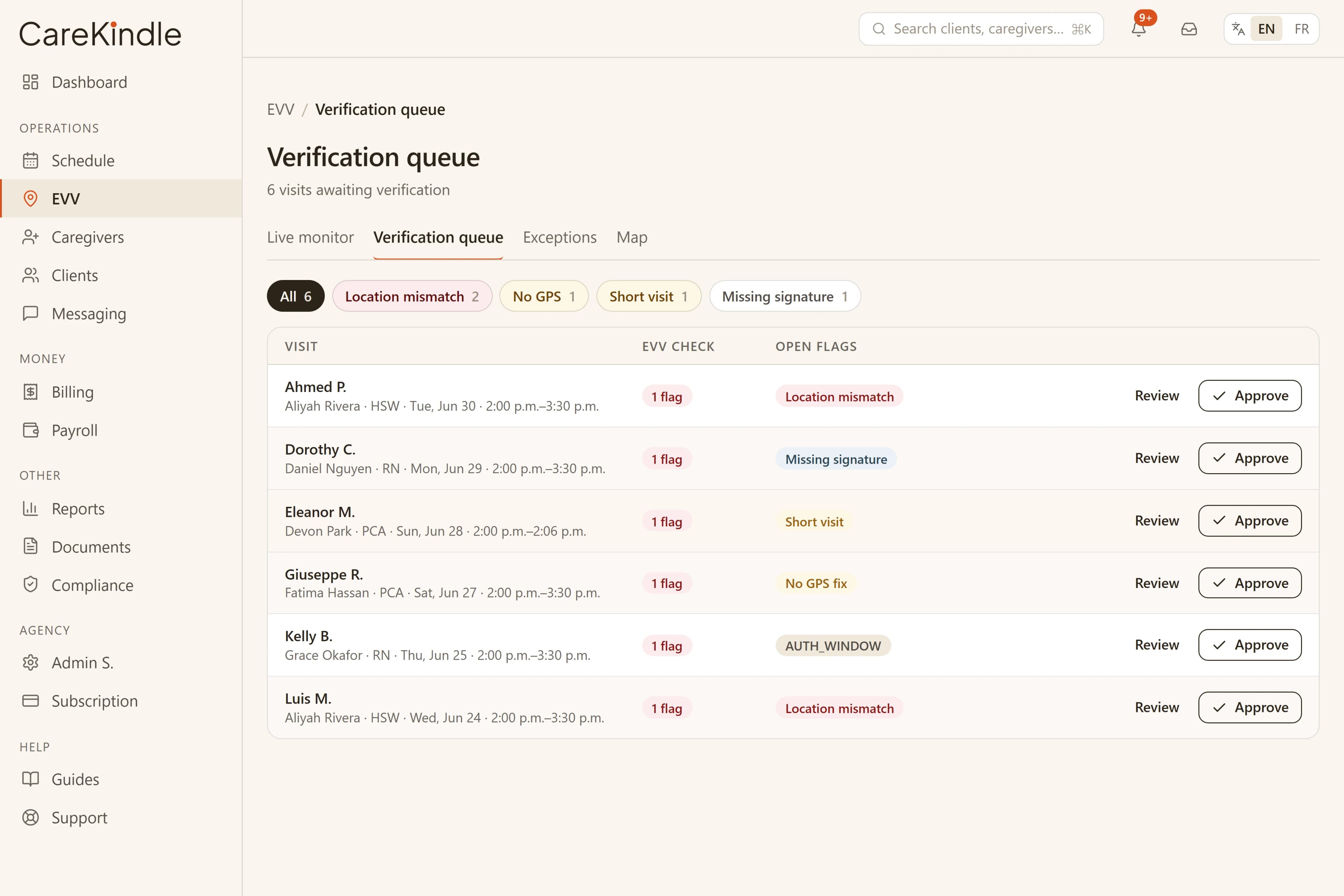
When a visit drifts from plan, it surfaces in the exception queue. A late start, a no-show, or a check-out that never arrived becomes a clear item to work, not a surprise discovered the next day. The office is notified of a missed visit so a coordinator can act, and you decide which alerts reach a caregiver as a reminder versus which reach a supervisor.
Working the queue is how an agency turns verification into care. Reassign a visit, follow up with the caregiver, or reach the family, and the action you took stays attached to the visit, so the next person who looks knows exactly what happened.
- One live view: not started, in progress, complete
- Late, missed, and never-closed visits raised automatically
- Office notified of missed visits so a coordinator can respond
- The follow-up you took stays attached to the visit
A tamper-evident audit trail
Every meaningful action around a visit (the check-in, the check-out, a manual verification, an exception worked, a record viewed) is written to an append-only audit log. The trail records what happened, to which record, and by whom, without storing raw health details in the audit entry itself.
That trail is what makes a verification defensible. When a funder reconciles billed hours, when a family asks whether a visit took place, or when you review an incident internally, the answer is a record that was written as events occurred rather than reconstructed afterward.
CareKindle is built so this proof is the natural byproduct of doing the work, not a separate reporting chore. Visit data is encrypted in transit and at rest, access is tenant-isolated, and the audit surface keeps your handling of personal health information aligned with PHIPA and PIPEDA. This guide is operational guidance, not legal or tax advice; confirm your own program obligations with your funder and advisors.
See how CareKindle turns every visit into proof you can stand behind.
14-day trial · full access · no credit card.